Skip to content
Homelessness
Introduction
We started the project on homelessness in 2003. In our travels around the world, we met many people who drifted or lived on the street. We really wondered how this was possible and whether something could be done about it. We spoke with many of them and learned that not two people were alike. Most had experienced some personal tragedy or were victims of a systemic failure that happened to them. In Montevideo we met a man, just standing in the street staring into the void. He told us that some months earlier his house burnt down, his wife and daughter inside died in the flames. He did not want to live anymore and stood there waiting for death.
Prejudice is the same everywhere. We walked in Rangoon with a local and met some beggars with leprosy. “Don’t give them any money,” he said. “They are rich, but don’t want to spend their money.”
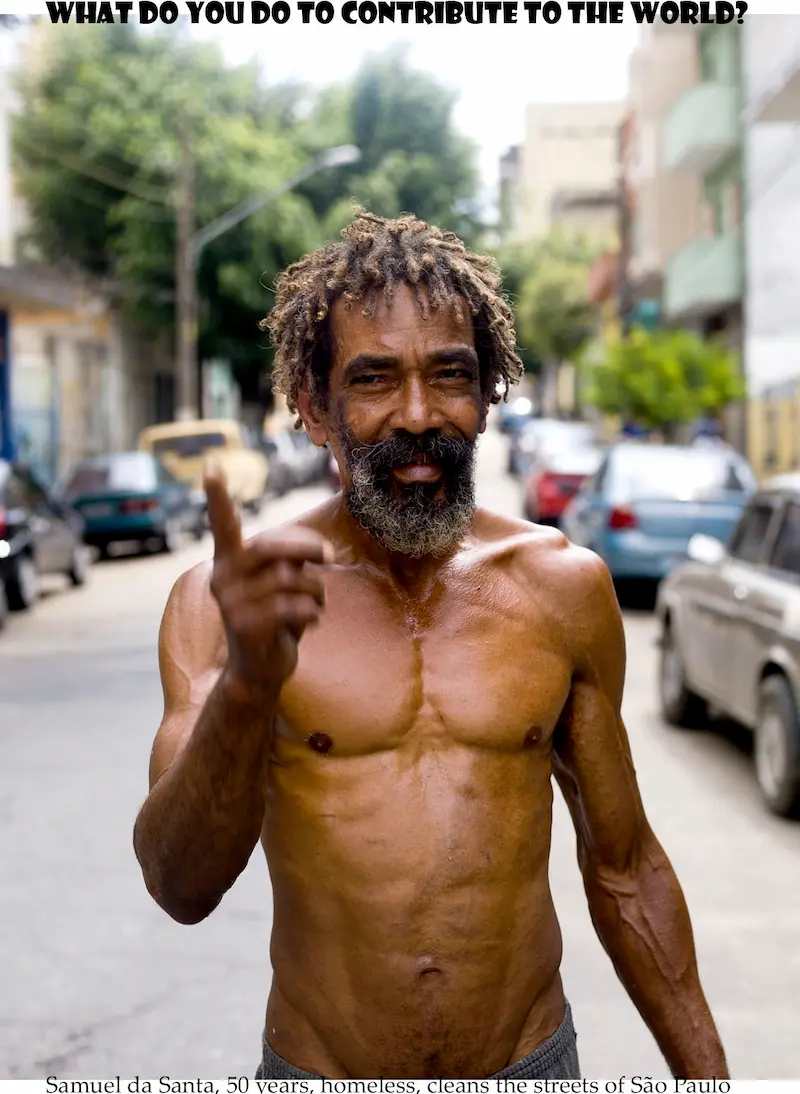
So far, we have created the content of our website with them and met many wonderful people. We carried out various projects with them, such as starting a fashion modelling agency with street people. We lived with a group that was cleaning the streets, sorting the material out and selling it to middlemen who came and went with their trucks. Samuel da Santa was one of them.
We found it difficult to work with institutions. In São Paulo we ended up dealing with the police, who demanded that we stopped the projects because we could not interfere in the programmes of the city. The street sleepers belonged to the city. Literally. We could give money to the institutions if we wanted to help.
Treating them as a homogeneous group of people will not help them. We too often encountered institutions that treated them as ‘the street people’ problem.
Another problem we see is that mostly Christian organisations are helping them. It should be more the responsibility of public institutions.
In Dhaka during an art exhibition, we invited them to visit the gallery, which caused some uproar. They were the uninvited. It was very unpleasant for them.
Some Findings
A home is a fundamental human right. Still one in every five people does not have adequate housing. Although we spend trillions on the manufacturing of semiconductor chips and on missions to Mars, one in every five people does not have a proper home. That is a choice, by the rich. As long as this choice is not abandoned, we will continue to see people living on the streets.
Homelessness takes on many different forms across societies worldwide. In some countries, it manifests as makeshift villages simply without houses. In others, it appears as tribe-like communities, where people live together and move through the city, collecting and working with waste wherever they go. Many homeless people are also alone.
We have witnessed this firsthand in São Paulo, where we lived in the city centre. People come to the city to find work or for many other reasons. When they fail to do so, their condition steadily deteriorates, they become dirtier by the day and increasingly disconnected from reality. One day they lie down on the street in their own filth, dead. We lived with their tribes under the vast highway overpasses of São Paulo. Many older people lose their homes in Brazil because their pensions are not sufficient to pay the ever-rising rent.
We saw in Tijuana what happened to the people that were deported from the USA. Complete villages lined the riverbanks, their dwellers aggressive and full of anger. Even throwing stones at us while we wanted to approach them. Some people had lived and worked in the USA for 30 years and had no place to go in Tijuana or Mexico or anywhere else.

We noticed in Africa the young people on the streets, not able to do anything for their own sake. Too few jobs, too little economic activity, schools out of reach. The interest rates their countries had to pay to the Wall Street banks was 20% or more. A friend of ours had three boys taking care of his horse at the beach. Every time we went there, they sat there, loyal but idle. He paid them well.
Someone shared their grief with us. The Western nations plundered their countries and pummeled their citizens during the colonisation. Made them slaves. When finally free from the occupiers, they found themselves in debt to the banks of the same occupiers. Having already paid back 10 times what they borrowed. And when people try to migrate to those countries that became rich because of this, they are not allowed in and labelled as fortune seekers, which is treated as a crime.
We stayed in the shacks of Dhaka where people try to make a living and live with their families along the streets under plastic roofs. Their life expectancy is low. We drank tea at a shack next to a shopping mall. The husband worked as a guard in the shopping mall, the wife cleaned rooms in a hotel. He had a disease but could not pay for medication. The shack was not more than some plastic sheeting on the street. They had to pay rent for it.
It is a choice. In many capitalist theories they are considered necessary to maintain a cheap labour force. In England, there have been laws prohibiting the poor from moving elsewhere because they were needed when work was available.
In still other countries like the USA, living on the streets is chosen over institutional mental health care or for reasons of addiction. In most cases it is driven by lack of money. We saw complete villages of addicted and mentally ill, mixed with elderly people. These “villages can be found in most cities of the USA. The American dream. It is their choice, the rich. China shows that it is not necessary.
Because these choices are made at a level over which ordinary people have little influence. Because the immigrant (the foreigner, the other) is framed as a threat by populist politicians, the question concerning homelessness is unlikely to be solved any time soon. Because the poor are framed as the others, awareness of this may be the starting point for change. That poverty is a choice, by the rich. That a historic conscience is lacking. That it easily could be different if chosen.
What will we do?
Want to know more?
Visit www.homeless-oftheworld.com